
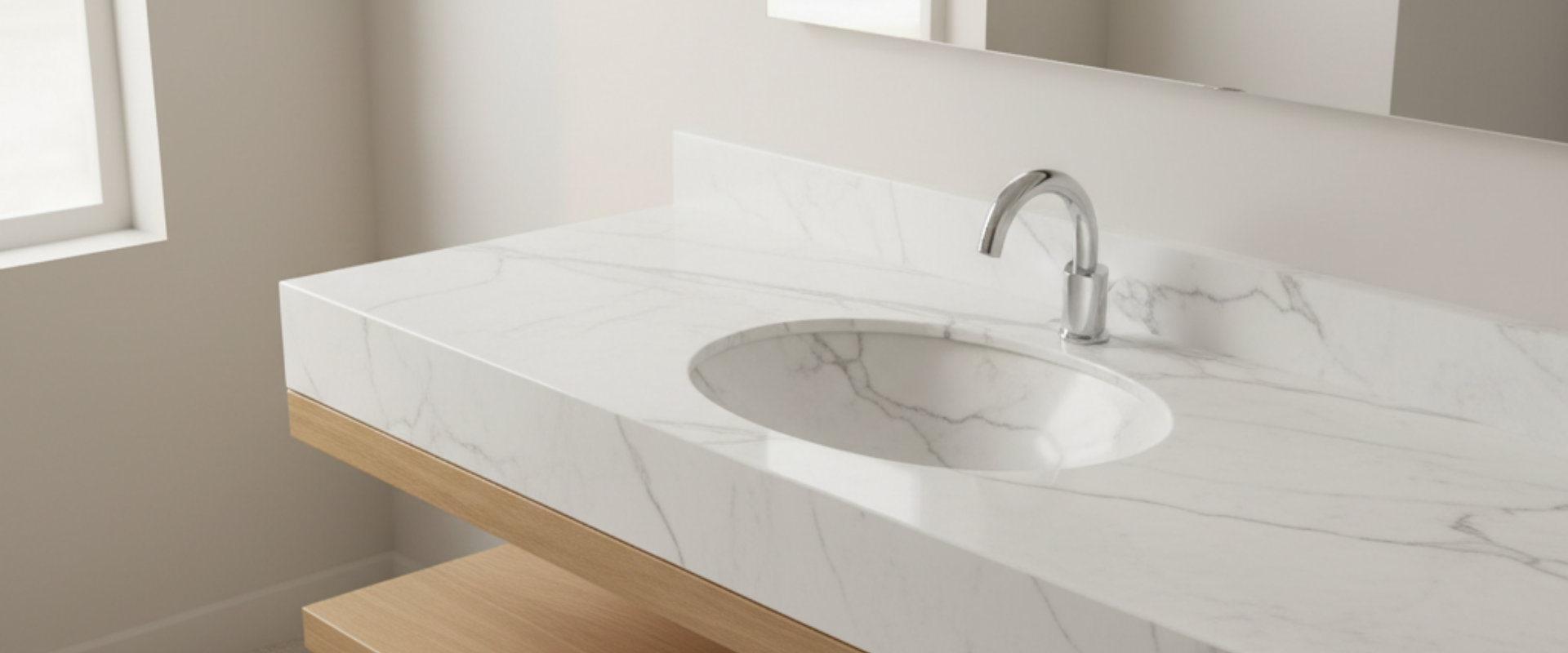
What is Cultured Marble?
Cultured marble is an engineered surface made from approximately 75% crushed marble dust and polyester resin, cast in a mold and sealed with a 100% non-porous gel coat. It requires no sealing, is up to 40% lighter than natural stone, and at scale costs up to 50% less than quartz vanity tops — making it the dominant material for non porous bathroom vanity tops in North American hospitality and multifamily projects.
Also known as: engineered marble, cast marble, marble composite, synthetic marble, man-made marble. See Wikipedia: Cultured marble for the material classification.
Material Properties
Gel coat surface blocks moisture, mold, and bacteria. No sealing ever required.
Up to 40% lighter than natural stone — reduces structural load and installation labor.
Marble, quartz, and solid looks. Custom proprietary colors available.
Bowl and surface cast together — no seams, no undermount clips, no silicone joints.
IAPMO Z124 certified. Meets North American plumbing code requirements.
Smooth gel coat finish available in gloss or matte across all colors.
The Cost & Weight Advantage
Cultured marble is materially less expensive and significantly lighter than the two most common alternatives — engineered quartz and natural stone. These two gaps are the reason cultured marble has dominated U.S. hospitality and multifamily bathroom renovations for the last three decades.
Wholesale Cost Index
Relative cost per square foot at truckload volume (Quartz = 100)
Up to 50% lower wholesale cost than engineered quartz. Directional figures reflecting typical North American B2B pricing; source: National Kitchen & Bath Association industry data.
Relative Weight
Installed weight per square foot (Natural Stone = 100)
Up to 40% lighter than natural stone — reduces structural load, eases installation, and lowers freight cost on truckload orders.
A Brief History of Cultured Marble
The engineered composite now known as cultured marble has been used in North American bathrooms for more than six decades. Its durability, groutless construction, and cost advantage over quarried stone have made it the dominant non-porous vanity top and shower wall material for commercial projects. See Wikipedia: Cultured marble for the general material classification and the International Cast Polymer Alliance (ICPA) for industry standards.
Origins in post-war housing
Cultured marble emerged in the United States during the 1960s as a cost-effective, lighter alternative to quarried marble for bathroom vanities in production housing. The material combined crushed marble dust with polyester resin — a technology adapted from the marine fiberglass industry.
Gel coat and standards
The polymer gel coat finish — the visible non-porous layer — was refined during the 1970s, solving early problems with surface yellowing and chemical resistance. The American National Standards Institute published ANSI Z124 to govern performance requirements for plastic plumbing fixtures, giving the industry a common durability benchmark.
Hospitality adoption
As hotel chains expanded renovation programs in the 1990s, cultured marble became the dominant shower wall material because its groutless, one-piece construction eliminated the mold and mildew problems associated with tile. The cost advantage over quartz and natural stone accelerated adoption in multifamily and senior living developments.
ARSTAR founded
ARSTAR Inc. was founded in 2002 in Monterrey, Mexico, with distribution from Laredo, Texas. Over 24+ years of operation the company has manufactured cultured marble vanity tops, shower walls, and shower pans for distributors, retailers, builders, cabinet manufacturers, and hospitality procurement teams across the United States and Canada under CSA B45.5, IAPMO Z124, ANSI, and ISO 9001:2015 certifications.
How Cultured Marble is Made
Gel Coat Application
A protective polymer gel coat is sprayed into the mold surface. This coat — the same marine-grade technology used in boat hulls and laboratory benchtops — becomes the finished visible surface: 100% non-porous, stain-resistant, UV-stable, and available in 12 colors and patterns. Gel coat thickness is controlled within a tight tolerance to guarantee long-term durability.
Resin & Marble Casting
A blend of polyester resin, crushed marble dust (calcium carbonate, typically ~75% by weight), and mineral pigments is poured over the gel coat. ARSTAR sources approximately 95% of its raw materials from within the United States to support predictable cost and quality. The mixture fills every contour of the mold and bonds chemically to the gel coat as it sets.
Controlled Curing & Demolding
The piece cures at controlled temperature and ambient humidity. Polyester resin cross-links and hardens into a rigid, seamless unit over several hours. Once fully set, the finished surface is demolded as a single one-piece casting — no joints, no silicone, no undermount clips, no assembly.
Quality Inspection & Packing
Every piece is inspected for dimensional accuracy, surface quality, color consistency, and edge finish. Rejected pieces are remanufactured — not repaired. Accepted pieces are wrapped for full truckload (FTL) shipping from ARSTAR's distribution facility in Laredo, Texas. The full process runs under ISO 9001:2015 Quality Management System controls.

Manufactured in Monterrey, Nuevo León, Mexico since 2002. ISO 9001:2015 certified. Approximately 95% of raw materials sourced from within the United States. Distribution from Laredo, Texas with standard lead times of 2–4 weeks.
Cultured Marble vs. Quartz vs. Natural Stone vs. Tile
| Feature | Cultured Marble | Quartz | Natural Stone | Ceramic Tile |
|---|---|---|---|---|
| Porosity | Non-porous | Non-porous | Porous | Grout is porous |
| Sealing Required | Never | Never | Annually | Grout needs sealing |
| Integral Bowl | Yes — one-piece | No | No | No |
| Weight | Up to 40% lighter | Heavy | Heaviest | Moderate |
| Custom Colors | 12 options | Limited palette | Natural only | Wide but grouted |
| Installation Speed | Fast — one-piece | Moderate | Slow — heavy | Slowest — tile + grout |
| Grout Lines | Zero | Zero | Zero | Many |
| Price Point | Budget-friendly | Mid-high | Highest | Low-mid |
| Mold Resistance | Excellent | Good | Poor | Poor (grout) |
| Repairability | Gel coat repairable | Difficult | Difficult | Replace tiles |
Care & Maintenance
Cultured marble requires minimal maintenance. No sealing, no special cleaners, no professional care.
Do
- Clean with mild soap and water
- Use non-abrasive bathroom cleaners
- Wipe spills promptly
- Use soft cloths or sponges
Don't
- Use abrasive scrubbers or steel wool
- Apply harsh chemicals (bleach, ammonia)
- Leave standing chemicals on the surface
- Use abrasive pads (Scotch-Brite green side)
Frequently Asked Questions
What is cultured marble made of?
Cultured marble is made from a blend of crushed marble dust (calcium carbonate) and polyester resin. The mixture is poured into a mold and sealed with a non-porous gel coat finish. The result is a solid, one-piece surface that looks like natural marble but is lighter, non-porous, and requires no sealing.
Is cultured marble the same as natural marble?
No. Natural marble is quarried stone that is porous and requires regular sealing. Cultured marble is an engineered composite that mimics the look of natural marble but is 100% non-porous, lighter, and available in 12 colors and patterns including Carrara and Calacatta.
How does cultured marble compare to quartz?
Both are non-porous and require no sealing. However, cultured marble is up to 40% lighter, costs less at volume, and can be cast with integral bowls — eliminating separate sink purchases. Quartz cannot be molded with integral bowls and has a more limited color palette.
How long does cultured marble last?
With proper care, cultured marble surfaces last 20+ years. The gel coat surface is repairable — minor scratches and chips can be buffed or filled without replacing the entire piece. ARSTAR products carry a 5-year warranty on gel coat and structure.
Does cultured marble stain or yellow?
Modern cultured marble with a quality gel coat does not yellow under normal use. The non-porous surface resists staining from soap, cosmetics, and household chemicals. Avoid prolonged contact with hair dye, nail polish remover, or harsh solvents.
Can cultured marble be used in showers?
Yes. Cultured marble is widely used for shower wall panels and shower pans. The non-porous, groutless surface eliminates the mold and mildew problems associated with tile grout. ARSTAR offers 7 shower panel patterns and 11 shower pan configurations.
Is cultured marble good for hotels?
Cultured marble is the preferred material for hotel bathrooms because it eliminates grout maintenance, installs faster than tile, and provides consistent color matching across hundreds of rooms. ARSTAR supplies groutless shower systems and vanity tops for hotel renovation and new construction.
Where is ARSTAR cultured marble manufactured?
ARSTAR manufactures cultured marble surfaces in Monterrey, Nuevo León, México, with distribution from Laredo, Texas. The company has been in continuous operation since 2002 and manufactures under ISO 9001:2015 Quality Management System controls. Approximately 95% of raw materials are sourced from within the United States.
How long has cultured marble been used in commercial projects?
Cultured marble was first commercialized in the United States in the 1960s as a lighter, lower-cost alternative to natural marble for residential bathrooms. It became the dominant shower wall material for hospitality and multifamily projects during the 1990s because its groutless, one-piece construction eliminated mold and mildew problems associated with tile grout. Today it is the most widely specified non-porous surface for hotel bathroom renovations in North America.
Is cultured marble sustainable?
Cultured marble is manufactured from two main raw materials — crushed marble dust (calcium carbonate) and polyester resin. Both are inert and long-lived: a well-maintained cultured marble surface lasts 20+ years without sealing, refinishing, or replacement, reducing lifecycle material consumption. ARSTAR sources approximately 95% of raw materials from within the United States, reducing transportation emissions compared to quarried natural stone imported from Europe or Asia. The single-piece casting process also produces less on-site waste than tile installations.
Last updated:
Non Porous Bathroom Vanity Tops for Commercial Projects
For hotel, multifamily, and senior-living procurement teams, the single most important property of a bathroom surface is whether it is non porous. Porous materials — natural marble, granite, ceramic tile grout — absorb moisture, harbor mold and bacteria, stain from soap and cosmetics, and require periodic sealing throughout the lifecycle of the building. Cultured marble has zero open porosity at the gel-coat surface, which is why it has been the dominant non porous bathroom vanity top material for U.S. and Canadian hospitality renovations since the 1990s.
The non-porous gel coat is the same family of marine-grade polymer used in boat hulls and laboratory benchtops. It blocks moisture, resists the chemicals found in routine bathroom cleaning, and meets the durability requirements of CSA B45.5 (the Canadian plumbing fixture standard) and IAPMO Z124 (the U.S. counterpart). Both standards govern impact resistance, structural integrity, color stability, and chemical resistance for plastic plumbing fixtures.
Compared to engineered stone (quartz), cultured marble is up to 50% less expensive at wholesale volume and is the only material that can be cast as a single piece with an integral bowl — eliminating the seam between countertop and sink that is the most common failure point in hotel bathrooms. Compared to solid surface (Corian), cultured marble offers a similar non-porous gel coat finish at materially lower cost. According to the National Kitchen & Bath Association, engineered and cast surface materials are the fastest-growing segment of the B2B vanity top market because of the combination of durability, consistency, and groutless installation they deliver.
Three Vanity Top Collections
ARSTAR organizes its cultured marble vanity tops into three collections, each with dozens of models available in 12 colors.
Classic Collection
Time-tested oval and square bowl silhouettes in 19″ and 22″ depths, plus drop-in and undermount configurations. The core B2B program for hospitality renovations and multifamily builder projects. Includes the Oval Series and the Camila Series.
- Oval 19
- Oval 22
- Oval Drop-In
- Camila 19
- Camila 22
- Camila Drop-In
- Camila Undermount
Contemporary Collection
Modern bowl profiles and edge configurations for hotel renovations, boutique hospitality, and high-spec multifamily. Wave, rectangular, and oval bowls across four series: Charlotte, Contempo, Carolina, and Capri.
- Charlotte
- Charlotte Wave
- Charlotte Square
- Contempo
- Contempo No Backsplash
- Carolina
- Carolina No Backsplash
- Capri
- Capri Small
Minimalistic Collection
Three stand-alone models with clean, understated profiles for contemporary residential and boutique hospitality. Rectangular, square, and wave bowl shapes in shallow-to-standard depths.
- Catherine
- Christine
- Alexa
Explore ARSTAR Cultured Marble Products
Vanity tops, shower panels, and shower pans — all in 12 colors. CSA B45.5 certified, ships FOB Laredo TX.